Collaborative Robots (Cobots)
A collaborative robot, or cobot, is an arm designed to work in the same space as a person. It looks much like a small industrial arm, and the difference is in its safety design and how it is used.
Typical characteristics
- Safety by design. Cobots use rounded shapes, limited speed and force, and often a sensor in each joint, so a person who bumps into the robot is not hurt. Several gallery entries describe torque sensing in every joint, such as ABB’s GoFa and Doosan’s M1013.
- Six or seven axes. Six revolute joints are the most common. Some cobots add a seventh axis for redundancy, such as the Franka and the Kinova Gen3. A redundant arm can reach the same tool pose in more than one way, which helps it get around obstacles.
- Dual-arm cobots. ABB’s YuMi has two independent 7-axis arms for small-parts assembly.
- Lighter payloads. A cobot generally carries less and works at lower speed than an industrial arm of the same reach, because it limits its own force.
- Easy to set up. Many can be moved by hand to teach a position, and they mount on tables, carts and stands.
- Size families. Several makers offer one mechanism in many sizes. The gallery’s UR e-Series is one six-axis design from the UR3e up to the UR20, and JAKA Zu covers nine payload classes.

A seven-axis cobot, the Franka Research 3 from the gallery, with its gripper. The seventh joint gives the arm redundancy.
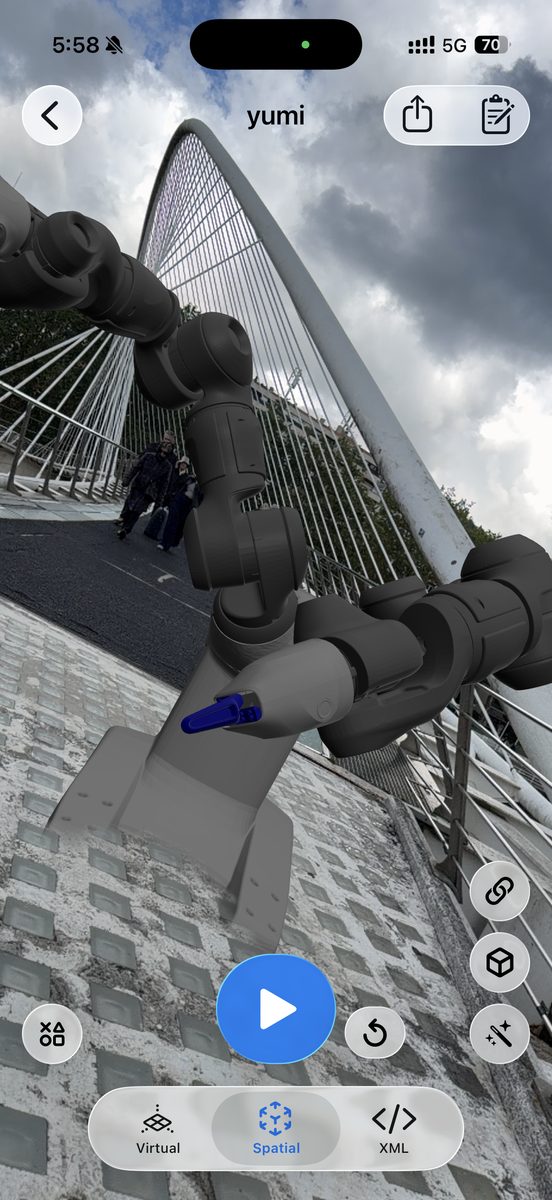
A dual-arm cobot, ABB’s YuMi, placed on the floor in ARMOR’s Spatial view.
The safety standards
Cobot safety is defined by standards, and the standards describe the whole application, not only the robot. ISO 10218 covers the safety of industrial robots and robot systems. The technical specification ISO/TS 15066 added guidance for collaborative operation, and its content has since moved into the 2025 revision of ISO 10218. It names four ways a robot and a person can share a space:
- A safety-rated monitored stop, where the robot halts when a person enters.
- Hand guiding, where the person moves the robot directly.
- Speed and separation monitoring, where the robot slows as a person gets closer.
- Power and force limiting, where contact is kept below limits for the body region it could touch.
ISO’s short introduction to the 2016 specification explains the idea. A cobot is not automatically safe: the tool it carries, the speed it moves and the parts it handles all change the risk, so the application is assessed as a whole.
In a URDF and in ARMOR
- Fixed base. Like industrial arms, cobots import with a fixed (welded) base. See Worlds & Robot Placement.
- Safety hardware is not in the file. Torque sensors, safety controllers and force limiting are properties of the real controller. A URDF describes the mechanism, so ARMOR shows the arm and its joint limits, not its safety behavior. ARMOR also does not simulate sensors; it keeps them in the file.
- Joint limits and effort limits. A cobot’s joint ranges, speed and effort limits come through in the description, and ARMOR uses the effort limit as a force limit on generated actuators. See ros2_control Actuators.
- Redundant arms. A 7-axis arm has one more joint than a pose needs. In ARMOR that shows up as an extra joint to move or control.
- Grippers. Many cobots are sold with a parallel-jaw gripper, whose second finger follows the first through a mimic joint. The Franka entry, for example, includes its optional gripper.
- Masses. Cobot descriptions from the makers usually include masses. If one does not, use Mass and Inertia.
Real-world use and tradeoffs
Cobots make sense where a person and a robot share a task: machine tending, packaging, light assembly, lab automation, and research. They are quick to deploy and easy to reprogram, so they suit small batches and changing work.
The tradeoff is performance. Because the robot limits its own speed and force, a cobot is slower than an industrial arm of similar reach, and carries less. If a task needs the fastest cycle or a heavy payload, an industrial arm in a guarded cell is usually the better fit. Some makers now sell cobots with larger payloads, and the line between the classes is not sharp.
Where the field is heading
As of late 2026, two changes stand out: cobots are getting bigger and faster, and the safety standards now treat the whole application as what gets validated.
- Bigger and faster. Cobots now reach payloads of 30 to 35 kg and tool speeds near 5 m/s, which blurs the line with industrial arms. Universal Robots launched the UR15 in May 2025 and offers the 30 kg UR30, and in September 2026 it announced a new Gen 7 platform (Automation World). At the small end, FANUC announced the 3 kg CRX-3iA in April 2026.
- Safety rules. The 2025 revision of ISO 10218 (Part 1, Part 2) takes in the collaborative-operation content that used to live in ISO/TS 15066, and it validates the collaborative application as a whole, not the robot on its own. The power and force limits for contact carry over unchanged. The US adopted ANSI/A3 R15.06-2025 in September 2025. A3’s FAQ on the updated ISO 10218 is a good summary. Check which document your application cites.
- Learning on low-cost arms. Open, inexpensive leader-follower arms have made it easy for anyone to collect demonstrations and train policies. See Indie and Desktop Robots.
Examples in the gallery
Browse the gallery’s Cobots filter. Some starting points:
- UR e-Series and UR Series and g-Series: Universal Robots’ six-axis cobots.
- ABB GoFa: a 5 kg-payload cobot with torque sensing in every joint.
- FANUC CRX-10iA: a 10 kg-payload cobot with built-in force sensing.
- Franka: a 7-axis research arm, in the Franka Research 3 and Panda generations.
- Kinova Gen3: a 7-axis research arm with back-drivable joints.
- ABB YuMi: a dual-arm cobot.
- JAKA Zu: a family of six-axis cobots in many sizes.
- PAR6: an open collaborative arm that takes interchangeable grippers.
Where to find more models
- Vendor pages. Gallery entries link to the makers: Universal Robots, ABB, FANUC, Franka and Kinova.
- Research collections. mujoco_menagerie and awesome-robot-descriptions list many cobot descriptions.
- Maker repositories. For example franka_ros and doosan-robot2. See Finding URDF Files.
Next steps
- Industrial Arms: the class cobots grew out of.
- Joints: limits and mimic joints.
- ros2_control Actuators: how joints are driven in ARMOR’s simulation.