Humanoid Robots
A humanoid robot has a body shaped like ours: two legs, a torso, and usually two arms and a head. Some are built for research in walking, some for manipulating objects made for human hands, and some for both.
Typical characteristics
- Two legs that must balance. A biped is unstable by nature. It stays upright by continuously moving its feet and body, and most of the engineering effort goes into that.
- Many joints. A leg usually has six actuated joints: hip, knee and ankle. The Berkeley Humanoid has six per leg. Add a waist, arms, a head and hands, and the total climbs quickly. The gallery’s Unitree G1 starts at 23 DOF in its base build and goes up with dexterous hands, and AgiBot X2 has 31, with a three-axis waist and seven-axis arms.
- Hands drive the count. A dexterous hand can have ten or more motors. Entries with hands in the gallery can report several times the DOF of the same robot without them.
- Floating base. Nothing attaches the robot to the world. Its position is the result of its feet pushing against the ground.
- A range of sizes. From a child-sized research platform such as iCub to the full-size Unitree H1 at 1.8 m.
- Upper-body humanoids. Some, like Reachy 2, put the human-shaped upper body on a mobile base and skip the legs.
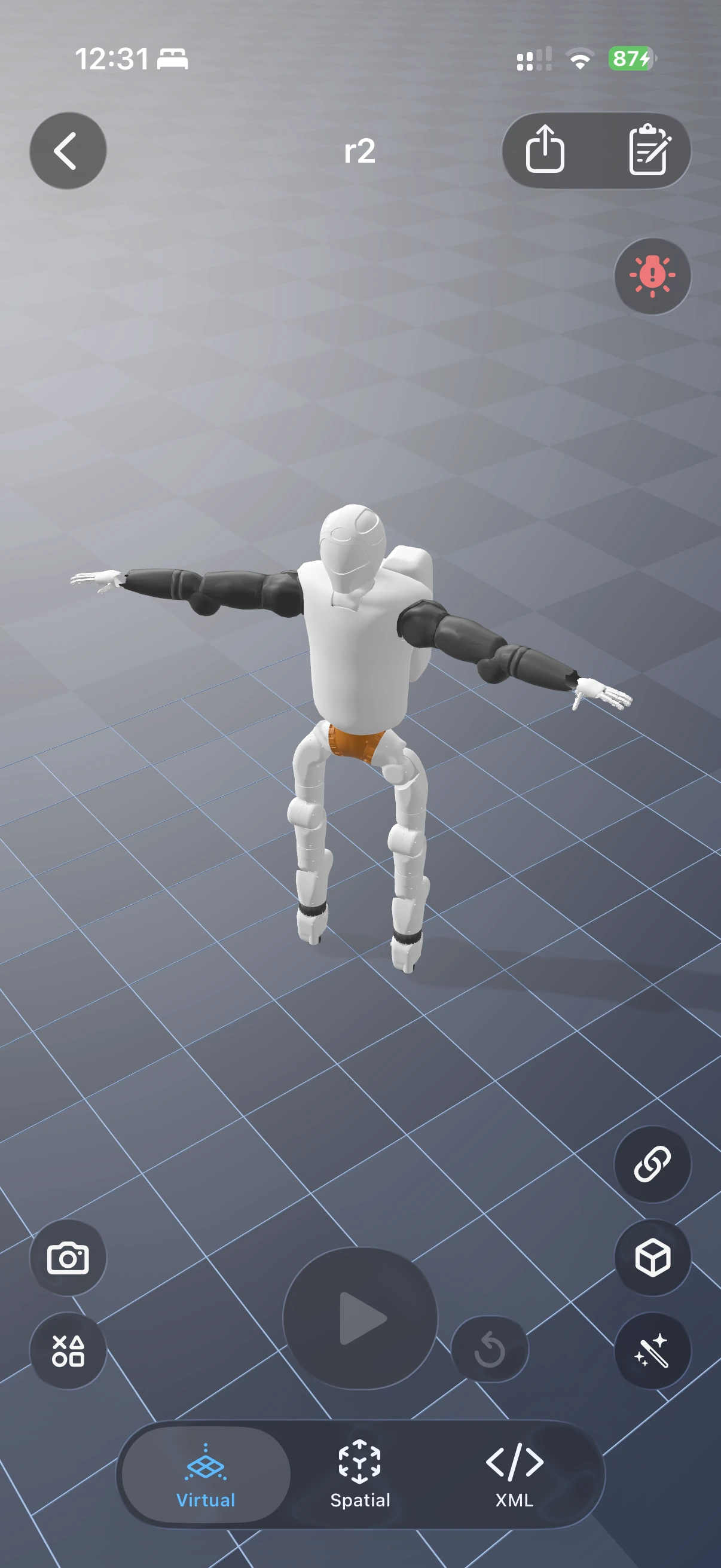
A humanoid in ARMOR’s Virtual view, standing on the ground plane it will push against in simulation.
In a URDF and in ARMOR
- Free-floating base. Choose a free-floating base so gravity and contact move the whole robot. See Worlds & Robot Placement. Gallery humanoids import as free-standing, placed just above the ground plane.
- A ground to stand on. Keep Ground Plane Contact on. The feet push against it, and its friction decides whether they grip.
- Tune the contact. If a foot slides or bounces, see Contact Parameters.
- Masses must be right. A humanoid is only believable if each link has a mass and a valid inertia. If MuJoCo reports Inertia must satisfy A + B >= C, see Mass and Inertia for the fix.
- Collision shapes. Descriptions often use simple boxes, cylinders and spheres for the feet and body, because detailed meshes are slow to simulate and can jitter. That is deliberate.
- Joints need something to drive them. A humanoid has to hold a pose against gravity, which takes actuators on its joints. Add Default Controllers gives every movable joint a position controller. See ros2_control Actuators. Balancing and walking are the job of a controller outside ARMOR.
- Hands. Fingers that move together are often coupled with mimic joints.
- Sensors. The IMU and cameras a humanoid carries are kept in the file but not simulated. See Sensors.
- Many variants. Several makers publish one humanoid with and without hands or arms. Pick the variant that matches your robot.
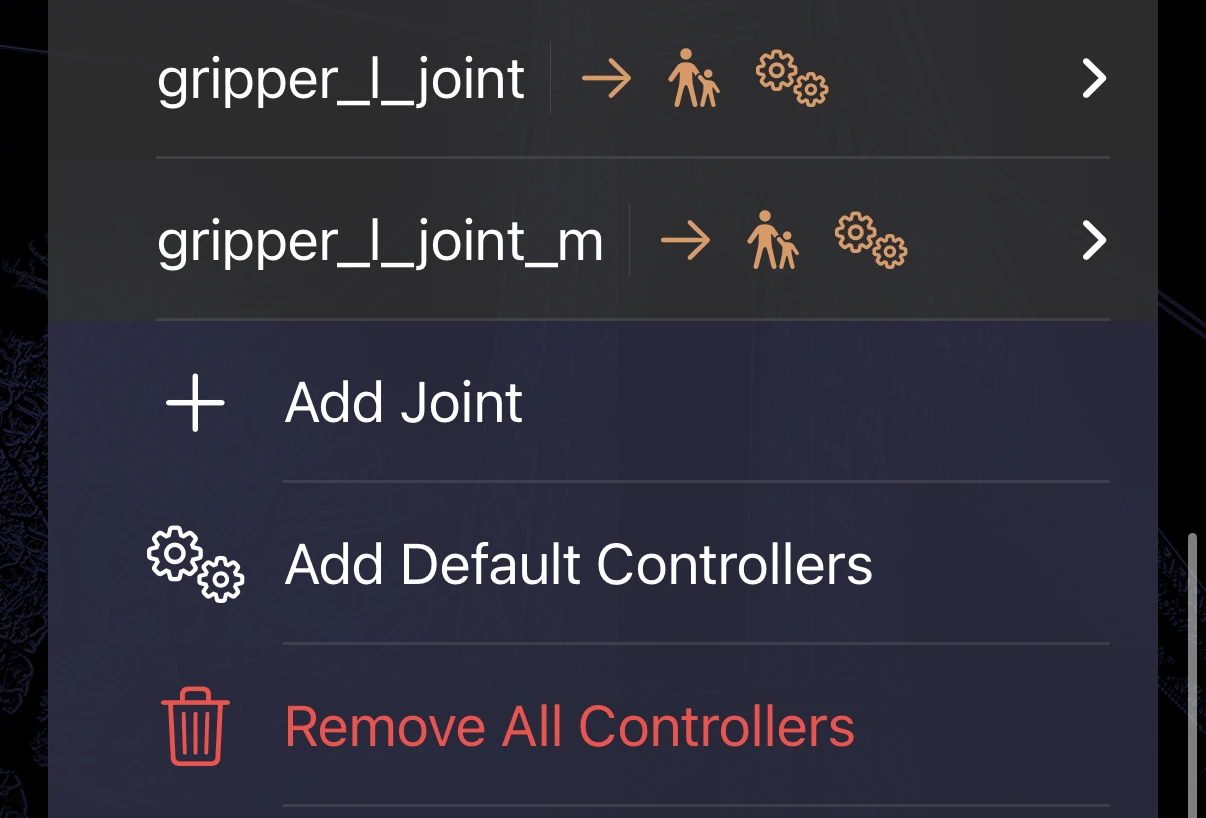
The Joints section of the robot editor, with the bulk controller actions below the joint list.
Real-world use and tradeoffs
Humanoids promise a robot that fits the human world: stairs, doors, tools and workstations. They are also the hardest class to build and control. Balance needs fast, powerful actuators and good sensing. The robot is heavy for its footprint, falls are costly, and battery life is short.
Much recent research trains humanoid walking in simulation with reinforcement learning and then moves the result to the real robot, which depends on accurate models. The Berkeley Humanoid paper describes a low-cost mid-scale research humanoid designed for this approach. The relevance to ARMOR is practical: the closer the URDF is to the hardware, the closer the simulation is to the real thing.
Choose a humanoid for research, for locomotion work, or for tasks that need human-shaped reach. For a single repeated task, an arm or a mobile robot is usually simpler and cheaper.
Where the field is heading
As of late 2026, humanoids fall into rough tiers, and the gap between a demo video and a working robot is large.
- Working, in narrow jobs. A small number do paid work such as moving totes. Agility’s Digit is deployed at customers including GXO and Schaeffler (Agility).
- Piloting. Several companies have robots in factory pilots. Boston Dynamics showed a production version of Atlas at CES 2026, with its first units allocated to Hyundai and Google DeepMind (Engadget).
- Announced. Many others have shown prototypes or announced plans. Treat shipment dates and numbers as targets until a deployment is confirmed.
- How they are controlled. A common pattern is reinforcement learning, trained in simulation, for the body’s balance and motion, with a vision-language-action model deciding the task. Reports of how well these models generalize mostly come from the developers themselves.
- Open platforms. Researchers can build their own: the Berkeley Humanoid Lite and ToddlerBot both publish their designs.
- Safety standards. There is no published safety standard written for humanoids yet. ISO 25785-1, which covers legged and actively balanced industrial robots, is still a draft (ISO).
Examples in the gallery
Browse the gallery’s Humanoid filter. Some starting points:
- Berkeley Humanoid: a compact, low-cost biped for locomotion research.
- iCub: IIT’s child-sized open-source research humanoid.
- Unitree G1 and Unitree H1: compact and full-size general-purpose humanoids.
- AgiBot X2: a full-size biped with a three-axis waist and seven-axis arms.
- Fourier GR-1: a full-body biped in two generations.
- Poppy Humanoid: an open-source, 3D-printed humanoid for research and education.
- Reachy 2: a humanoid upper body on an omnidirectional base.
Where to find more models
- Vendor pages. Gallery entries link to the makers, for example Unitree G1, iCub and Berkeley Humanoid.
- Unitree models. unitree_ros holds URDF descriptions of Unitree’s robots.
- MuJoCo Menagerie and descriptions indexes. mujoco_menagerie and awesome-robot-descriptions include several humanoids.
- Academic projects. Research labs often publish their robot’s description with the paper, as the Berkeley Humanoid does.
Next steps
- Mobile and Legged Robots: quadrupeds, hexapods and wheeled robots.
- Worlds & Robot Placement: fixed and free-floating bases.
- Troubleshooting Simulation Errors: what MuJoCo’s error messages mean.