Robot Classes
Robots come in families, and the family tells you a lot before you open the file. A six-axis arm bolted to a table, a humanoid that has to stay upright, and a quadcopter that never touches the ground all need different settings in a simulator. This section describes the main classes, what is typical of each, how each shows up in a URDF, and where to find examples.
Each class has its own page. The examples link to the robot gallery, where any robot can be opened in ARMOR in one tap.
The classes at a glance
| Class | Typical base | Typical joints | What sets it apart |
|---|---|---|---|
| Industrial arms | Fixed | 6 revolute (4 on SCARA) | Speed, payload and repeatability, usually working inside a guarded cell. |
| Cobots | Fixed | 6 or 7 revolute | Built to share a workspace with people, with force limits and often joint torque sensing. |
| Humanoids | Free-floating | 12 to 30 or more | Two legs and a torso that must balance, often with arms and hands. |
| Mobile and legged robots | Free-floating | 2 to 20 | Quadrupeds, hexapods, wheeled bases, wheel-legged hybrids and rovers that move through the world. |
| Aerial robots | Free-floating | Few joints, mostly rotors | Multirotors, helicopters and fixed-wing aircraft that fly. |
| Indie and desktop robots | Either | 2 to 20 | Low-cost, open-source and often 3D-printed robots for learning and tinkering. |
The classes overlap. A mobile manipulator is part wheeled base and part arm, and a desktop arm can be built like an industrial arm. The gallery files each robot under one category, so use these pages as a guide and not as strict boundaries.
Why the class matters in ARMOR
A few choices in ARMOR depend on the kind of robot you have loaded:
- Base type. An arm bolted to a surface needs a fixed (welded) base. A robot that walks, rolls or flies needs a free-floating base. See Worlds & Robot Placement. In a robot’s placement sheet, this is the Static (fixed base) switch. Gallery entries for free-standing robots come with the right setting.
- The ground. Legs and wheels need the ground plane to push against, and friction decides whether a foot grips or slides. An aerial robot has no use for it.
- Mass and inertia. Anything free-floating needs believable masses to behave, and many hobby descriptions leave them out. See Mass and Inertia.
- What drives the joints. A fixed-base arm can be posed and driven joint by joint. A robot with many joints that has to hold itself up needs actuators on its joints. See ros2_control Actuators.
- Coupled and looped mechanisms. A URDF describes a tree of links, so a gripper whose fingers move together, a parallelogram linkage, or a spring-legged biped is described with mimic joints or simplified. Each class page notes where this appears.
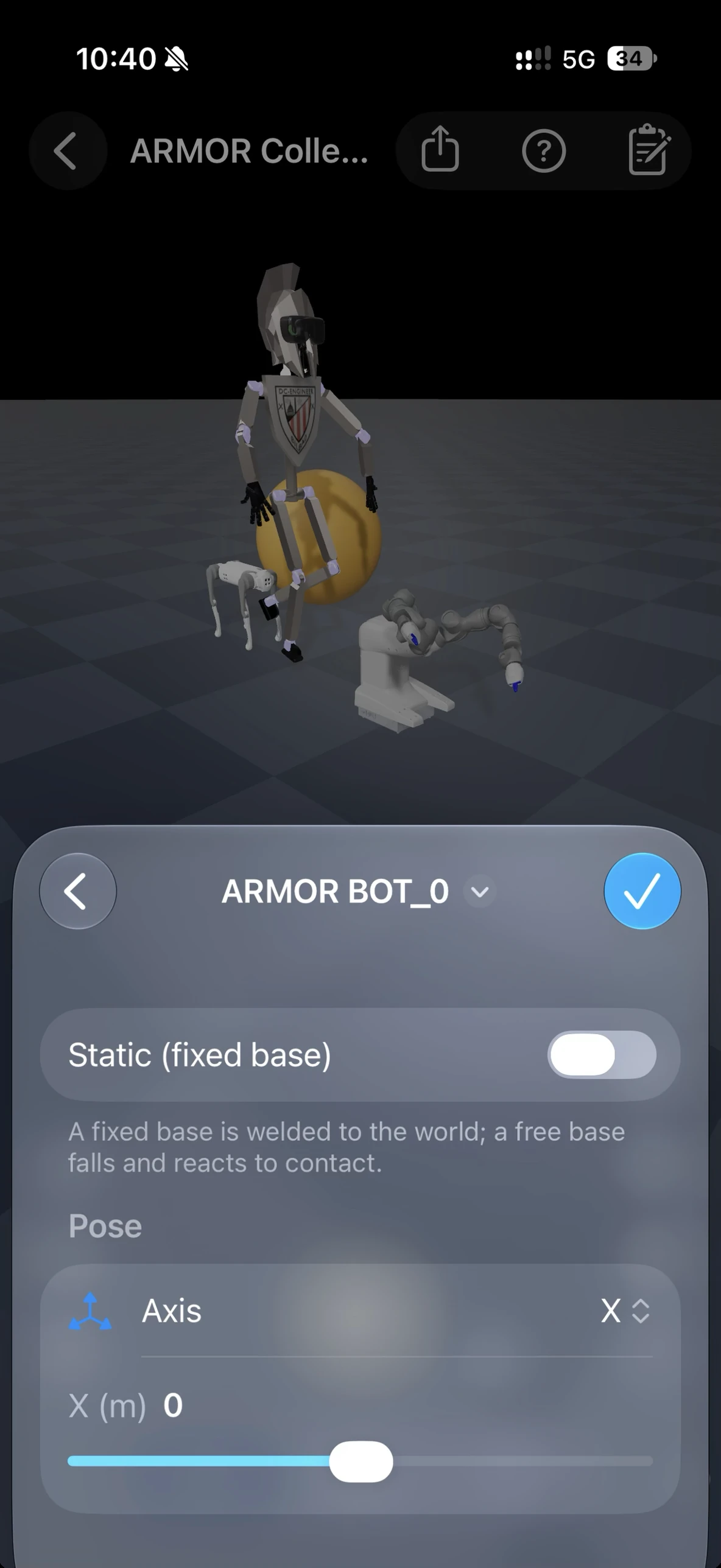
A robot’s placement sheet. With Static (fixed base) off, as here, the robot has a free base that falls and reacts to contact. Turn it on to weld the robot to the world.
Words used on these pages
- Degrees of freedom (DOF). The number of independent ways a robot’s joints can move. A gallery entry’s DOF counts actuated joints, and it can be lower than the number of joints in the file, because a mimic joint follows another one.
- Serial and parallel. A serial robot is one chain of links from base to tip. A parallel robot has several chains that share a platform.
- End effector. The tool at the end of an arm: a gripper, a hand, a welding torch.
- Payload and reach. How much an arm can carry, and how far it can stretch.
- Floating base. A robot whose root link is not attached to the world, so it can translate and rotate freely.
- Underactuated. Having fewer independent actuators than the robot has ways to move. Humanoids and multirotors are both examples.
Where the field is heading
As of late 2026, the common thread across every class is that the software around the robot is changing faster than the hardware.
- Learned control. Reinforcement learning trained in simulation is how most legged and humanoid robots learn to move, imitation learning is how many arms learn tasks from demonstrations, and large vision-language-action models are being tried for general tasks. Most claims about how well these models generalize come from their developers, so read them as research results.
- One physics stack. MuJoCo and its GPU versions, MJX and MuJoCo Warp, share the MJCF model format, and NVIDIA’s Isaac Lab 3.0 has a Newton physics backend. Newton, an open physics engine now hosted by the Linux Foundation and built by Disney Research, Google DeepMind and NVIDIA, loads URDF, MJCF and USD files.
- Several description formats. URDF stays the common language of ROS, and it describes a tree of links with no closed loops. MJCF adds constraints, tendons, actuators and sensors. USD describes whole scenes, and Isaac Sim imports URDF and MJCF into USD with a robot schema. Converting between them usually needs some manual cleanup.
- Safety rules move to the application. ISO 10218-1 and -2 were revised in 2025, and the US followed with ANSI/A3 R15.06-2025.
Each class page ends its main text with a short section on what is changing for that class. The numbers that make headlines, such as prices, shipment counts and market forecasts, change quickly and often disagree between sources, so these pages leave most of them out.
Reading about the standards
Three standards come up often for arms. ISO 8373 defines the vocabulary of robotics, including what counts as an industrial robot. The edition from 2021 is current, and a revision is in progress. ISO 10218, revised in 2025 as Part 1 (robots) and Part 2 (robot systems and integration), covers the safety of industrial robots, and it now includes the collaborative-operation requirements that used to be in the technical specification ISO/TS 15066. ISO’s note on that 2016 specification, Robots and humans can work together with new ISO guidance, is a short introduction to the four collaborative modes. For humanoids and other actively balanced robots, a safety standard, ISO 25785-1, is still in draft.
Next steps
- Finding URDF Files lists where to look for robot descriptions of any class.
- Robot Gallery & Deep Links explains how the gallery opens robots in ARMOR.
- Getting Started walks through loading your first robot.