Mobile and Legged Robots
This class covers robots that move through the world on legs or wheels: robot dogs, six-legged walkers, wheeled bases, hybrids of the two, and planetary rovers. They share one property that matters most in ARMOR: nothing attaches them to the world, so ground contact decides everything.
Typical characteristics
- Quadrupeds. Four legs, usually three actuated joints each (hip swing, hip lift and knee), which makes 12 DOF. Examples are Spot, ANYmal and Unitree Go2. Spot also carries an optional six-axis arm, and ANYmal a two-axis sensor head.
- Hexapods. Six legs with three joints each is 18 DOF, as in Interbotix Hexapod. More legs give a steadier stance than four.
- Bipeds. Cassie is a biped with legs and no upper body, so it is not a humanoid. Its legs use a spring and a passive four-bar linkage.
- Wheeled bases. Wheels are continuous joints. A differential-drive base, such as BB25, has two driven wheels and steers by driving them at different speeds. A skid-steer base, such as Clearpath’s Husky, has four wheels that turn the robot by sliding.
- Wheel-legged hybrids. Unitree Go2-W puts a wheel motor at the end of each leg, to climb with legs and roll fast on flat ground.
- Mobile manipulators. A wheeled base with an arm, such as Stretch 3, with its lift, telescoping arm and wrist.
- Rovers. Perseverance is a six-wheel rocker-bogie rover with a five-axis arm and a camera mast.
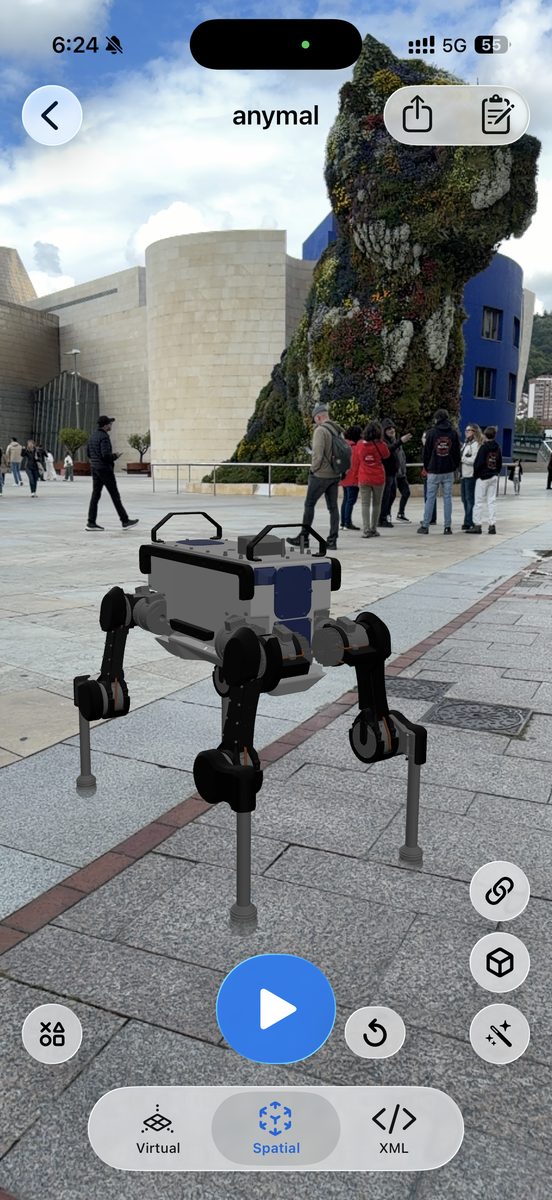
A quadruped, ANYbotics’ ANYmal from the gallery, standing on a plaza in ARMOR’s Spatial view.
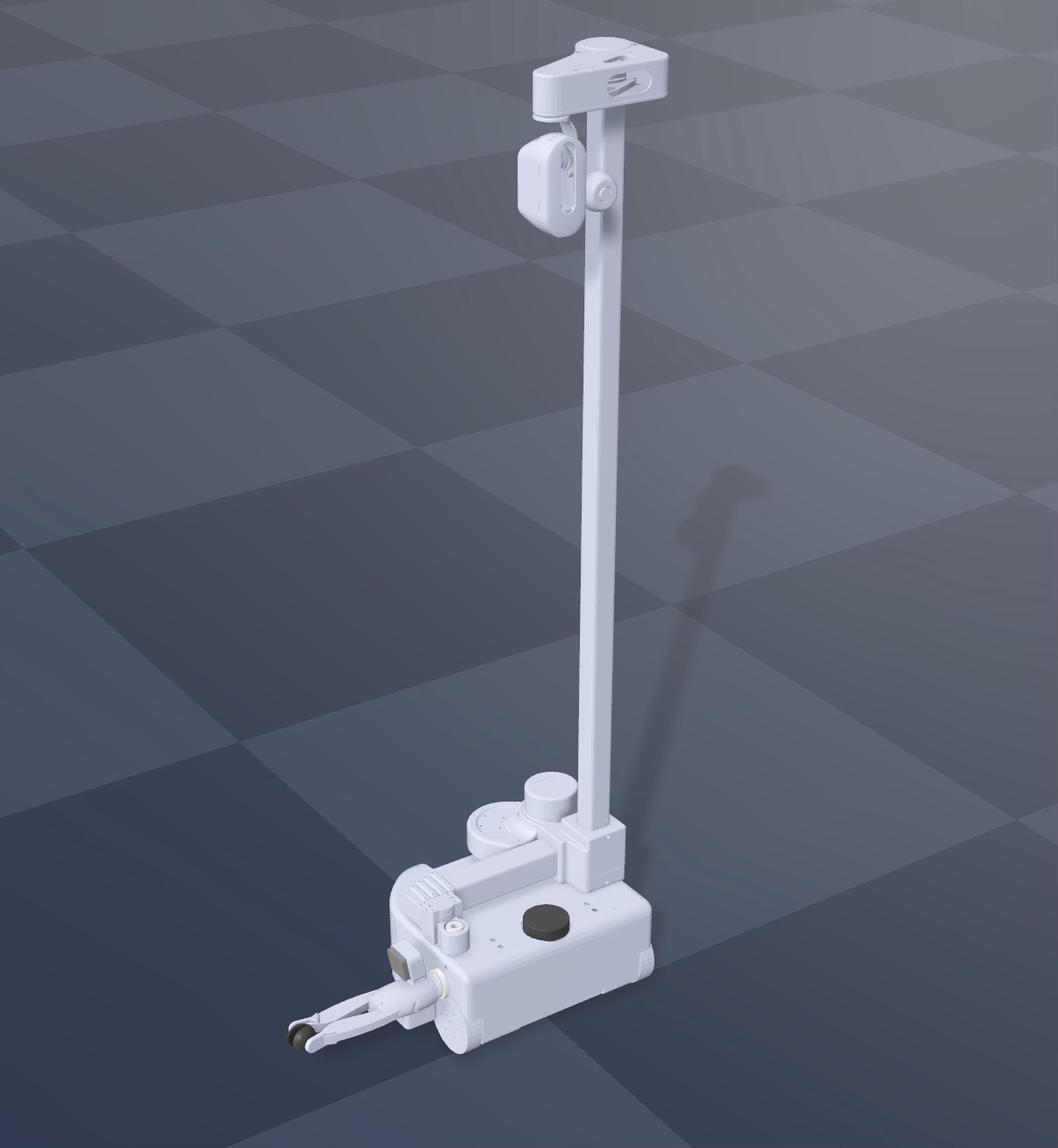
A mobile manipulator, Hello Robot’s Stretch 3 from the gallery, with its telescoping arm retracted. The wheeled base carries the lift mast and the camera head at the top.
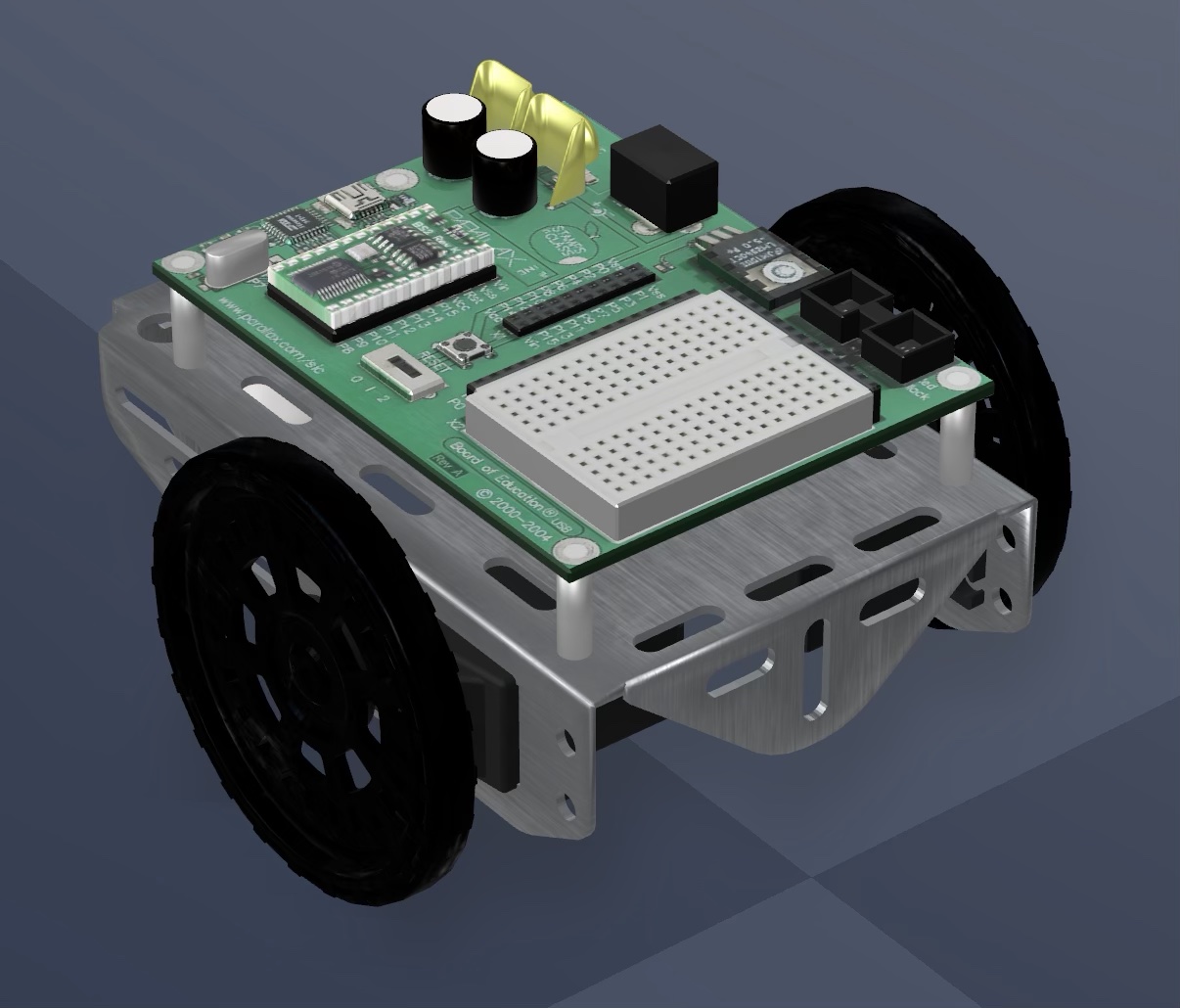
A differential-drive base, BB25 from the gallery, a model of the Parallax Board of Education Bot. Its two driven wheels are continuous joints.
In a URDF and in ARMOR
- Free-floating base. Choose a free-floating base. See Worlds & Robot Placement. Gallery entries for free-standing robots import this way and are placed just above the ground plane.
- Ground contact and friction. Legs and wheels work against the ground plane. A foot that grips and a wheel that slips are both decided by friction. Adjust it there, or with Contact Parameters.
- Wheels are continuous joints. They have no angle limit and spin freely. See the joint types in Joints.
- Legs need actuators. A legged robot has to hold its pose against gravity. Add Default Controllers gives each movable joint a position controller. See ros2_control Actuators. Walking itself needs a controller outside ARMOR.
- Legs with linkages. Some designs include coupled or looped linkages. A URDF is a tree, so these are described with mimic joints or simplified, and some of the real mechanism may be left out.
- Collision shapes. Feet are often small spheres, and bodies simple boxes, for stable contact.
- Masses. Free-floating robots depend on believable masses. See Mass and Inertia.
- Sensors. Lidar, cameras and IMUs on a mobile robot are kept in the file but not simulated. See Sensors.
Real-world use and tradeoffs
- Legs go where wheels cannot: stairs, rubble, steep or broken ground. They cost more, are mechanically complex, and use more energy for the same distance on flat floors.
- Wheels are simple, efficient and fast on flat or lightly rough ground, and they need fewer actuators. They stop at stairs and big obstacles.
- Hybrids trade complexity for both abilities.
Quadrupeds became a common research platform once control methods trained in simulation worked on hardware. Hwangbo and colleagues’ Learning agile and dynamic motor skills for legged robots trained a policy for ANYmal in simulation and ran it on the real robot, and Learning to Walk in Minutes Using Massively Parallel Deep Reinforcement Learning shows how quickly a legged policy can now be trained. Both depend on a faithful robot model, which is why the URDF details above matter.
Where the field is heading
As of late 2026, learned locomotion and open software are the main stories.
- Learned locomotion. Reinforcement learning, trained in simulation, now drives the best legged results. ETH Zurich’s ANYmal Parkour (Science Robotics, 2024) did it with a quadruped, and the RAI Institute trained an end-to-end policy that ran Spot far faster than its default controller (arXiv). The same training approach is now applied to humanoids.
- Low-cost mobile manipulation. Stanford’s Mobile ALOHA showed a wheeled, open-source base with two arms learning mobile manipulation tasks from demonstrations.
- Software. ROS 2 Lyrical Luth was released on 22 May 2026 as a long-term-support release (Open Robotics), and Nav2 remains the standard navigation stack.
- Industry moves. Amazon acquired the wheel-legged robot maker RIVR in March 2026.
Examples in the gallery
Browse the gallery’s Mobile & Legged filter. Some starting points:
- Spot, ANYmal, Unitree Go2: quadrupeds.
- Cassie: a spring-legged biped.
- Interbotix Hexapod: a six-legged walker.
- BB25: a small differential-drive base.
- Unitree Go2-W: a wheel-legged hybrid.
- Stretch 3: a mobile manipulator.
- Perseverance: NASA’s Mars rover.
Where to find more models
- Vendor pages. Gallery entries link to the makers, for example Boston Dynamics, ANYbotics, Unitree Go2 and Clearpath.
- Maker repositories. spot-sdk, unitree_ros and husky hold descriptions and tools.
- Collections. mujoco_menagerie and awesome-robot-descriptions list many legged and wheeled models.
- Related classes. Small, low-cost legged and wheeled robots are in Indie and Desktop Robots.
Next steps
- Ground Plane: contact and friction.
- Contact Parameters: bounce and friction for the whole scene.
- Aerial Robots: robots that leave the ground.