Aerial Robots
Aerial robots fly: multirotor drones, helicopters and fixed-wing aircraft. They are a small group in the gallery, and they behave differently from every other class, because the thing that holds them up is not a joint or a wheel.
Typical characteristics
- Multirotors. A quadrotor has four propellers, and it steers by changing their speeds. It has four motors for six ways to move, so it is underactuated. Crazyflie is a 27-gram open-source quadrotor, and AscTec Hummingbird is a research quadrotor.
- Helicopters. Ingenuity, NASA’s Mars helicopter, has two counter-rotating rotors on one mast and four landing legs.
- Fixed-wing aircraft. Techpod is a small hand-launched research airframe. It flies on its wings and propeller, not on rotors that lift it.
- Very light. Aerial robots are as light as their lift allows, and their parts are small.
In a URDF and in ARMOR
- A free-floating body. The body of an aerial robot is not attached to the world, so use a free-floating base. The URDF
floatingjoint type exists for this. See Joints and Worlds & Robot Placement. - Propellers are joints. In the Crazyflie description there are four continuous joints, one per propeller, and no other movable joints. The gallery counts them as the robot’s 4 DOF.
- The ground plane is optional. Turn Ground Plane Contact off if the robot should not rest on a floor. See Ground Plane. The gallery’s aerial entries are placed just above it.
- No flight model. ARMOR’s simulation is MuJoCo’s rigid-body physics with joint actuators. It does not include rotor thrust or aerodynamics, so a description of an aircraft behaves as a free body under gravity, and the propellers spinning do not lift it. Use ARMOR to view, inspect, edit and place these robots, including in augmented reality, and use a flight simulator for flight dynamics.
- Small scale and light masses. Check that the masses and sizes are plausible. If a part has no mass data, see Mass and Inertia.
- Sensors. Cameras and IMUs are kept in the file but not simulated. See Sensors.
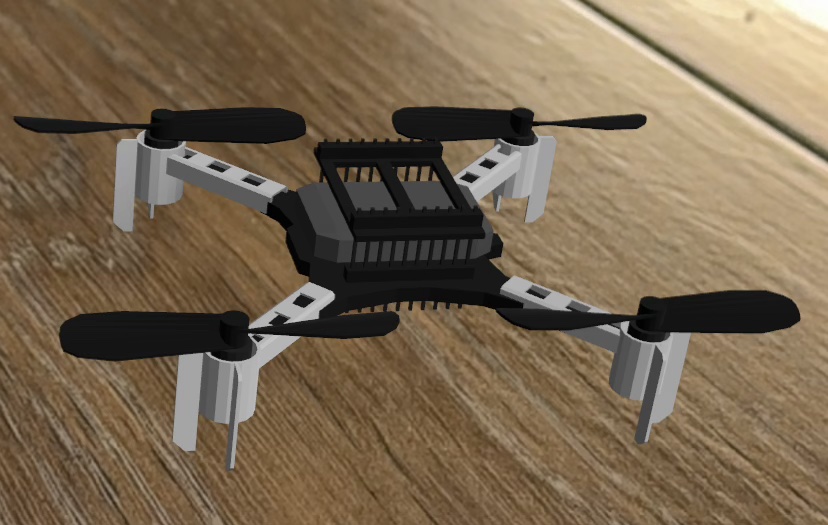
A quadrotor, Bitcraze’s Crazyflie from the gallery, placed on a wooden floor in ARMOR’s Spatial view. Each of the four propellers is a joint in the model.
Real-world use and tradeoffs
Multirotors are mechanically simple, can hover and move in any direction, and are used for inspection, photography, research and education. Their flight time is short, because holding weight in the air takes a lot of power. Helicopters carry more per rotor but add mechanical complexity. Fixed-wing aircraft cover distance efficiently but cannot hover, and they need to keep moving.
Aerial robots are studied as control problems in their own right, because they are fast, unstable and underactuated. Simulators built for flight, such as ETH Zurich’s RotorS, model the aerodynamics and the sensors that ARMOR does not. The Hummingbird and Techpod descriptions in the gallery come from RotorS.
Where the field is heading
- Racing and learned flight. In 2023 the University of Zurich’s Swift system beat three human drone-racing champions (UZH). It was less robust in conditions it had not seen, such as unusual lighting. Newer research aims to go straight from camera pixels to motor commands, for example Dream to Fly and SkyDreamer.
- Flight beyond Earth. NASA’s Ingenuity flew 72 times on Mars, from 19 April 2021 to 18 January 2024, for more than two hours in total (NASA). NASA’s Dragonfly rotorcraft for Saturn’s moon Titan is planned to launch no earlier than 2028 (JHU APL).
- Open autopilots and simulators. PX4 and ArduPilot are the common open flight controllers. Learning research uses GPU-parallel simulators such as Aerial Gym, and flight simulators still miss some aerodynamic effects at high speed, which is why a policy trained in simulation can behave differently on a real drone.
- Rules. In the US, Remote ID has been enforced since March 2024. Rules for flying beyond visual line of sight are still changing, so check the current regulations where you fly.
Examples in the gallery
Browse the gallery’s Aerial filter:
- Crazyflie: a palm-sized open-source quadrotor.
- Hummingbird: a research quadrotor, from the RotorS simulator.
- Ingenuity: NASA’s coaxial Mars helicopter.
- Techpod: a small fixed-wing research aircraft, from the RotorS simulator.
Where to find more models
- Maker pages. Bitcraze Crazyflie and NASA’s Mars Helicopter, which the gallery entries link to.
- Simulation repositories. Bitcraze’s crazyflie-simulation and ETH Zurich’s rotors_simulator hold descriptions of several aircraft.
- Collections. awesome-robot-descriptions indexes more, including drones.
Next steps
- Augmented Reality: place a drone on your desk.
- Ground Plane: turn the floor off.
- Mobile and Legged Robots: robots that stay on the ground.