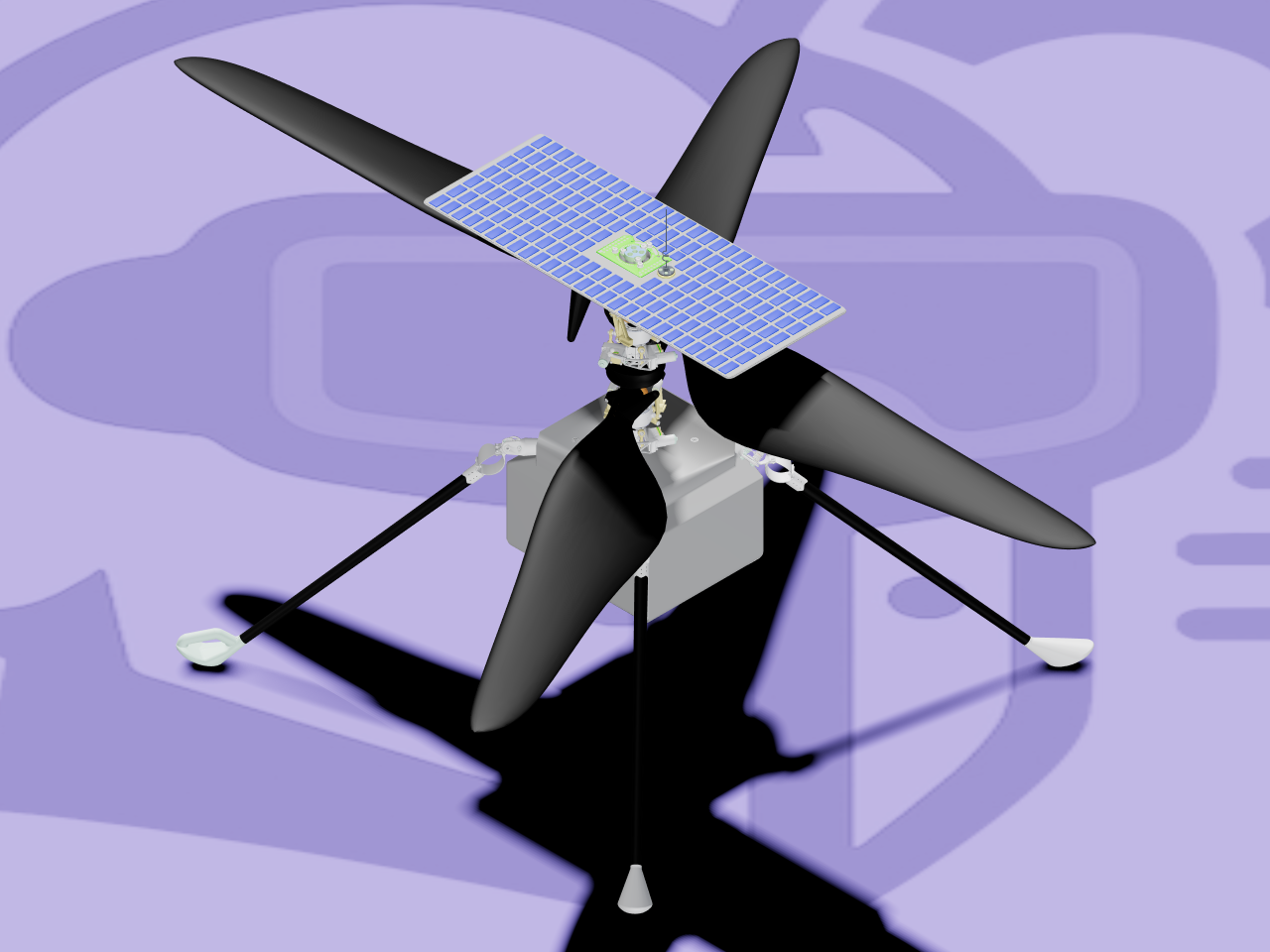
Ingenuity is NASA’s Mars Helicopter — the first powered aircraft to fly on another planet, carried to Mars attached to Perseverance’s belly and deployed in April 2021. Built to prove that rotorcraft flight was even possible in an atmosphere about 1% the density of Earth’s, it flew far beyond its planned five-flight technology demonstration, eventually logging dozens of flights as a scouting asset for the rover team before a hard landing ended its mission in January 2024. “MHS” in this repository’s own file names is JPL’s internal designation for the helicopter model — Mars Helicopter System.
The mechanism
Two co-axial, counter-rotating rotor blades stacked one above the other — the layout that
lets a small, light airframe generate enough lift without a tail rotor to cancel torque,
well suited to Mars’s thin air. Four legs, each on its own revolute hinge at the body,
swing outward from their stowed cruise position to the deployed flight/landing stance —
visible in this description as the “Joint_LegNN_Axis” joints. A fixed camera frame
(Frame_MHS_NAVCAM) marks the navigation camera’s mounting point but carries no geometry
of its own.
A caveat worth knowing: every link in this URDF declares zero mass. This is a visualization model, not a simulation-ready one — geometry and kinematics are complete and accurate, but there is no inertial data for a physics engine to act on.
About these files — read before importing
This links directly to JPL’s own m2020-urdf-models
repository, unmodified — the same repository as the Perseverance rover entry in this
gallery, published together as a pair. Its meshes are binary glTF 2.0 (.glb) files,
each one fully self-contained (geometry and per-part color both packed into the same file,
no external buffer or texture to fetch alongside it) — ARMOR fetches and parses them the
same way as any other format. Unlike most entries here, this repository carries no
license file and no stated license terms — see this page’s License section for what that
does and doesn’t mean for using it in ARMOR.