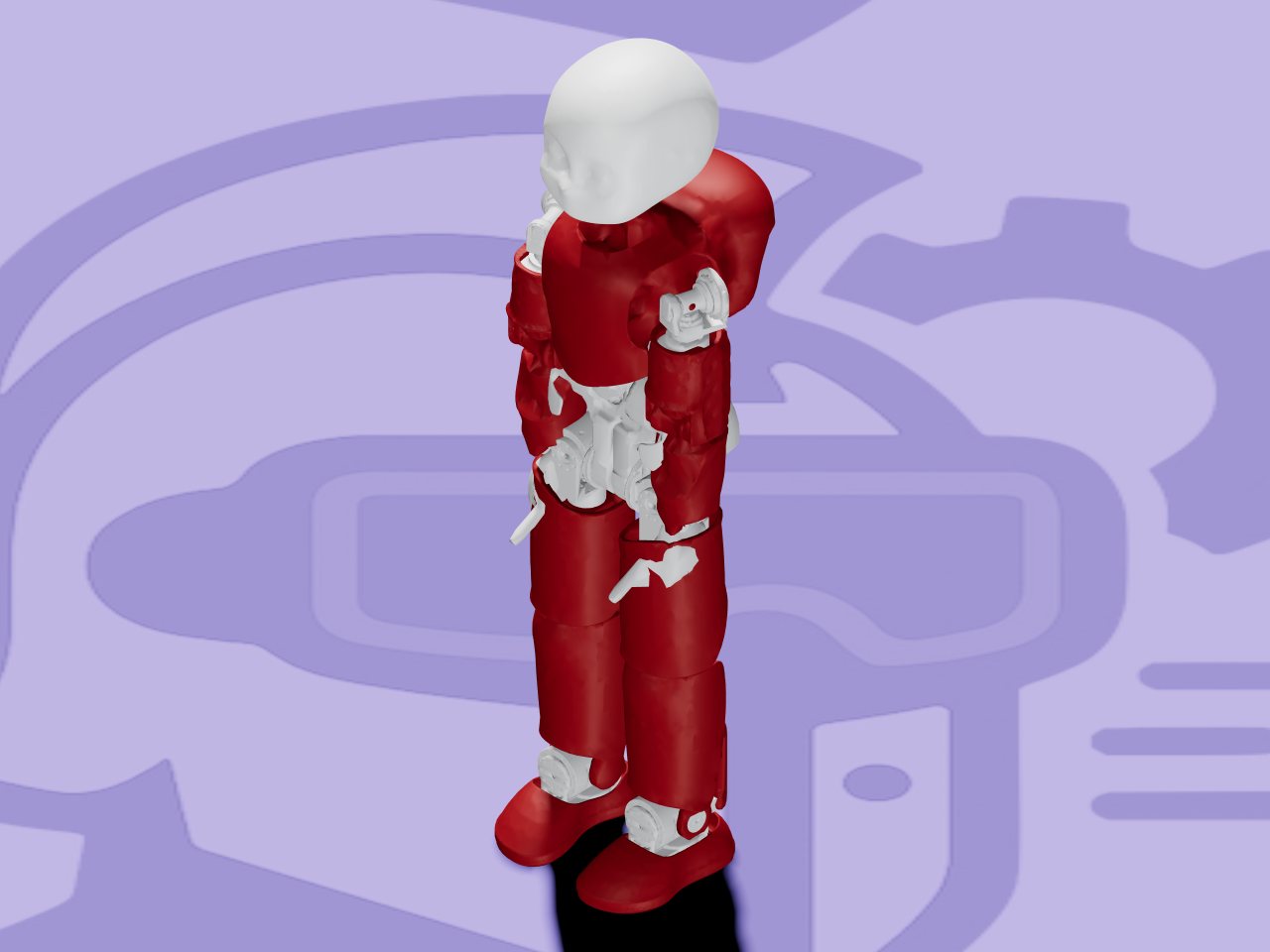
iCub is IIT’s landmark open-source humanoid research platform — a child-sized bipedal robot originally developed under the EU-funded RobotCub project starting in 2006, and still under active development nearly two decades later. It has been used across hundreds of embodied- cognition and humanoid-control publications worldwide, making it one of the most widely cited research humanoids in existence.
The mechanism
This model carries thirty-two actuated joints, all independently driven with no mimic joints or closed kinematic loops: six per leg (hip pitch/roll/yaw, knee, ankle pitch/roll), seven per arm (shoulder pitch/roll/yaw, elbow, wrist pitch/pronation-supination/yaw), three in the neck, and three in the torso. This particular configuration does not articulate the hands — the finger geometry is present but rigidly fixed, a common simplification for locomotion- and whole-body-control-focused simulation work. Real iCub hardware is more often cited with up to 53 DOF once hand articulation is included, but that figure doesn’t apply to this specific description.
About this file — read before importing
This links directly to
icub-models, IIT’s own repository, which
publishes over a dozen iCub model variants — most tied to a specific physical robot at a
specific lab. This entry uses iCubGazeboV2_7, the newest generic reference model
(v2.7 hardware), not bound to any single site’s configuration. ARMOR links directly to that
repository rather than re-hosting anything, so what you get is exactly what IIT publishes,
unmodified.