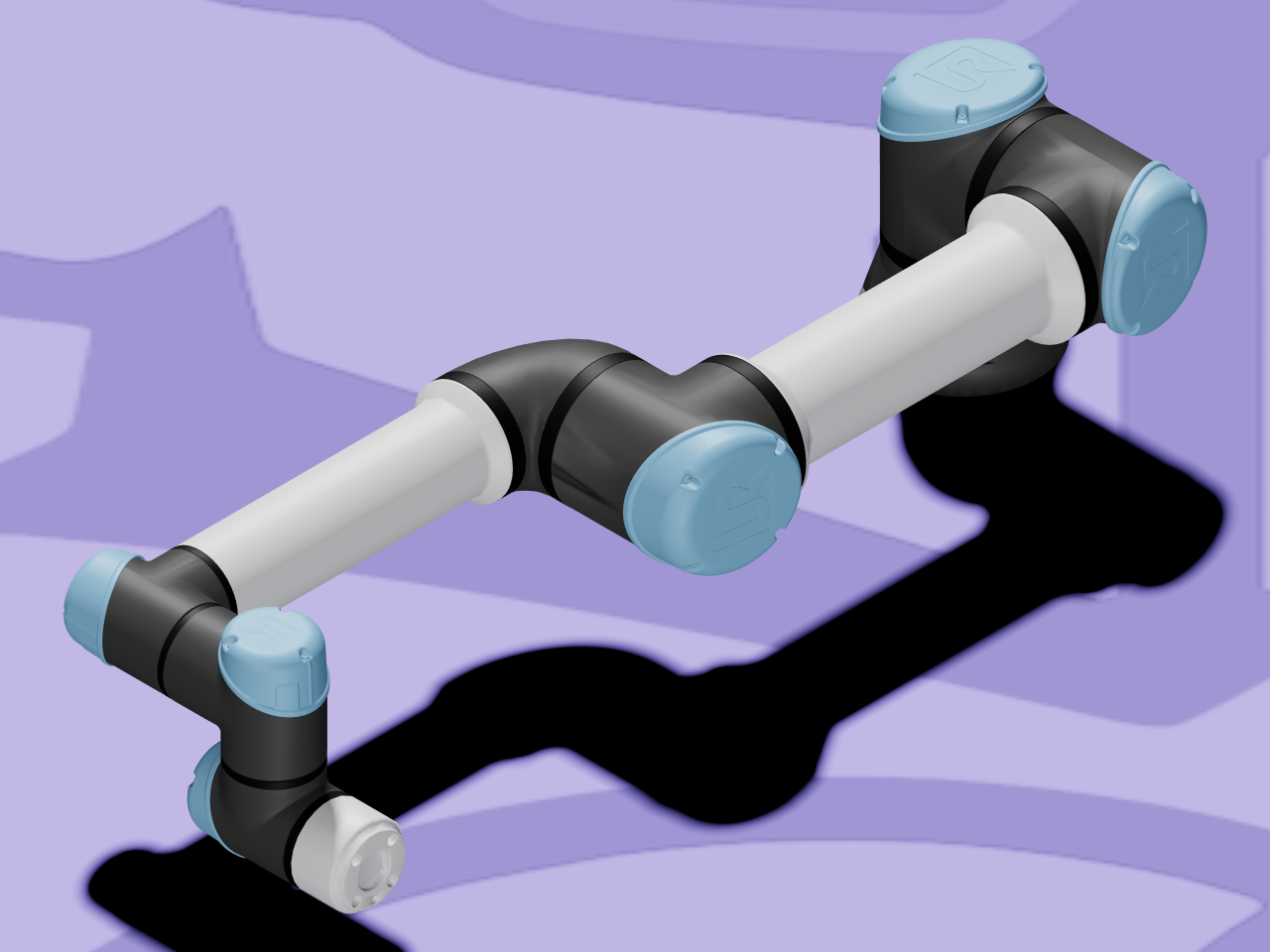
Universal Robots’ e-Series is the collaborative-arm lineup most people picture when they hear “cobot” — five sizes sharing one 6-axis mechanism, from the compact UR3e up through the mid-size UR5e, long-reach UR10e, high-payload UR16e, and heaviest UR20. Every size ships with force/torque-limited joints and rounded, pinch-point-free geometry so it can work directly alongside people without a safety cage — the defining trait of the collaborative-robot category UR pioneered.
The mechanism
Base, shoulder, upper arm, forearm, and three wrist joints (wrist 1/2/3) form a
textbook 6-axis serial arm on every model — no mimic joints, no closed loops, every
movable joint an independent actuator. base_link_inertia is a small internal frame
Universal Robots’ own description inserts to align the visual/physical model with the real
controller’s coordinate convention (REP-103 vs. the arm’s native frame); it isn’t a
seventh axis. The five sizes differ only in link dimensions, mass, and joint limits — the
mechanism itself is identical across the whole lineup.
Choosing a variant
All five are mechanically identical — the choice is purely which payload/reach class you need: UR3e for tight workspaces, UR5e for general-purpose light assembly (the most common model in labs), UR10e or UR16e for larger parts and higher payloads, or UR20 for the heaviest-duty tasks in the lineup.
About these files — read before importing
These files are not URDFs. Universal Robots publishes every e-Series model from one
shared, parameterized .urdf.xacro template — model identity comes entirely from which
ur_type config files get loaded, not a separate file per robot. This gallery entry links
directly to the official
Universal_Robots_ROS2_Description
repository, unmodified, configured per variant. ARMOR expands the macros itself after
downloading, so Open in ARMOR gives you a working robot — nothing here is a pre-baked
derivative of Universal Robots’ files.