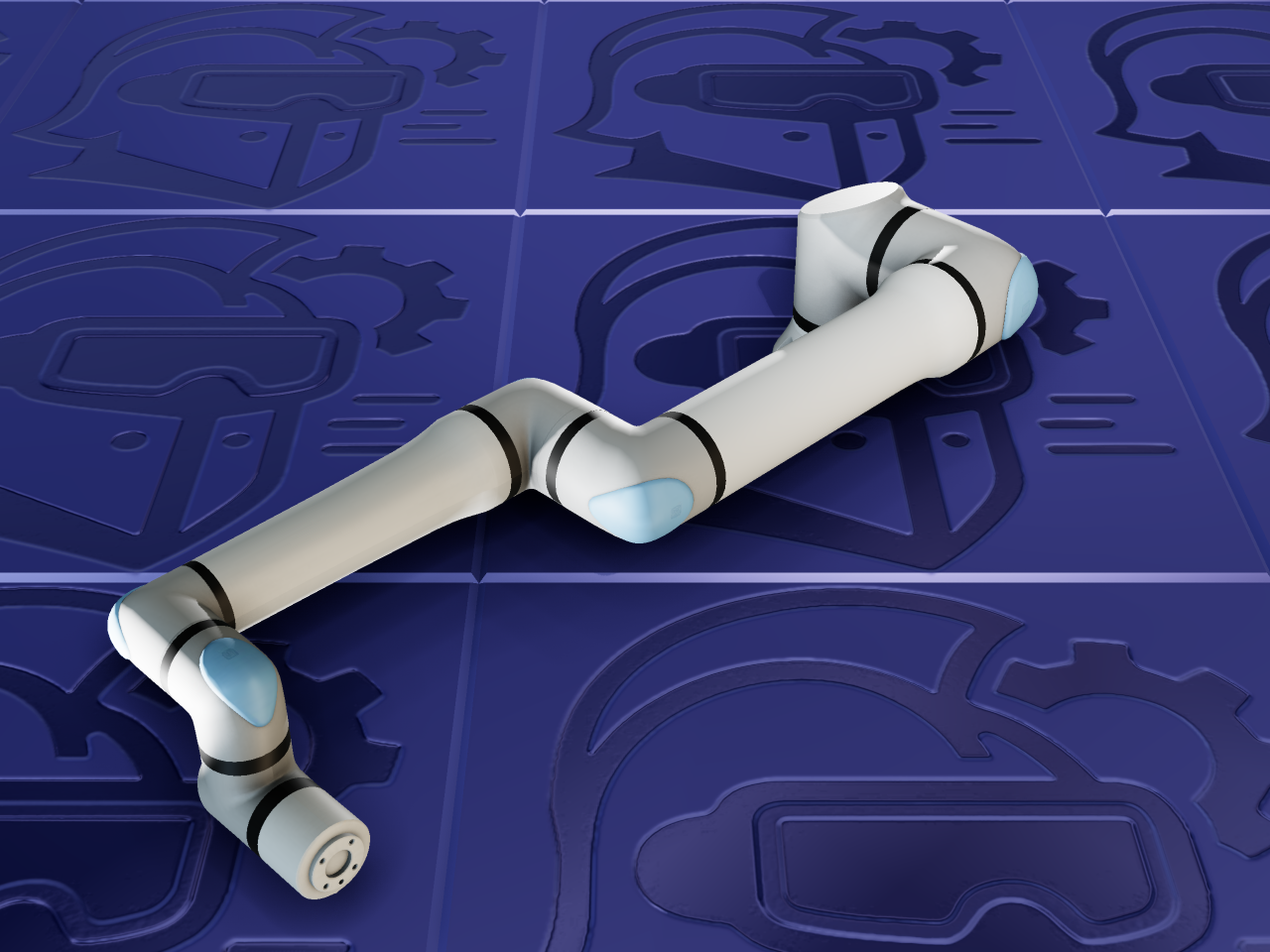
This entry gathers Universal Robots’ newer arm sizes in one place: the UR Series models UR8 Long, UR15, UR18, and UR30, and the g-Series models UR10g-1750, UR17g-1300, and UR18g-950, which Universal Robots added to its description repository on 22 October 2026. For the UR3e, UR5e, UR10e, UR16e, and UR20, see the UR e-Series entry.
The mechanism
Base, shoulder, upper arm, forearm, and three wrist joints (wrist 1, 2, and 3) form a
textbook 6-axis serial arm on every model, with no mimic joints and no closed loops, and
every joint an independent actuator. base_link_inertia is a small internal frame that
Universal Robots’ description inserts to align the model with the controller’s coordinate
convention; it is not a seventh axis. The sizes differ in link lengths, mass, joint
limits, and which meshes they use.
Which variant?
Each g-Series arm has the same link lengths and joint torque limits as one UR Series arm: the UR10g-1750 matches the UR8 Long, the UR17g-1300 matches the UR15, and the UR18g-950 matches the UR18. The g-Series variants also add a Smart Panel, an optional accessory on the last wrist link, which Universal Robots’ configuration turns on by default for them. The UR30 is the arm in this group with the highest joint torque limits.
License — read before building on these models
Every mesh in this entry is covered by Universal Robots’ Terms and Conditions for Use of Graphical Documentation, not the open-source BSD license that covers the rest of the repository. The terms allow you to create simulations and visualizations of Universal Robots’ products, and let hobbyists, students, and researchers make models for non-commercial use, but they forbid using the files to build a product that competes with Universal Robots’. Universal Robots states that the terms do not fully comply with the Open Source Definition. Read the license notice above before building on these files.
About these files — read before importing
These files are not URDFs. Universal Robots publishes every model from one shared,
parameterized .urdf.xacro template, and model identity comes from which configuration
files get loaded, not from a separate file per robot. This gallery entry links directly to
the official
Universal_Robots_ROS2_Description
repository, unmodified, configured per variant. ARMOR expands the macros itself after
downloading, so Open in ARMOR gives you a working robot, and nothing here is a
pre-baked derivative of Universal Robots’ files.