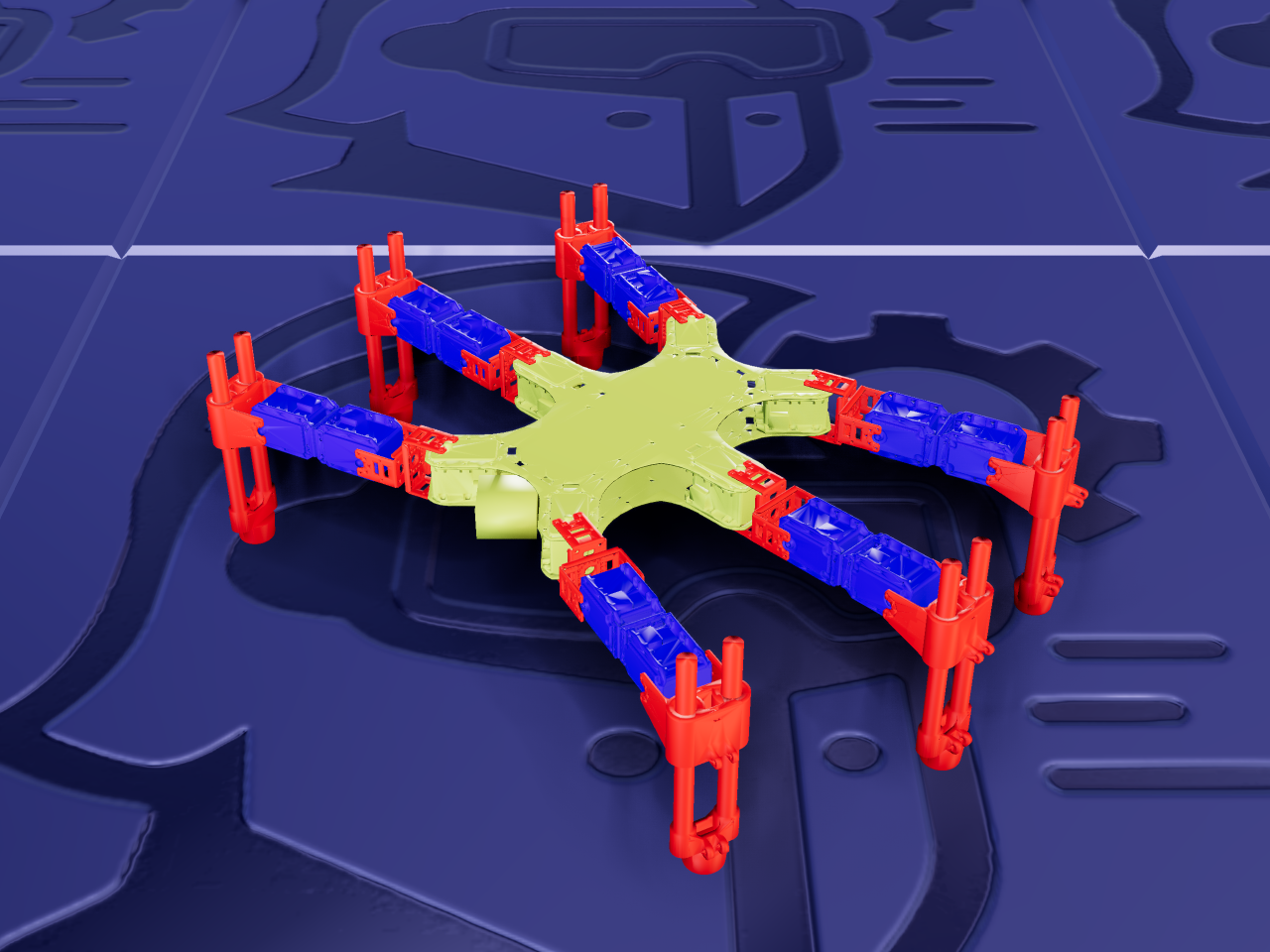
Pexod is the ERC ResiBots project’s research hexapod — a six-legged platform built for legged-locomotion research at the Inria/Sorbonne robotics labs, and the exact robot behind Cully, Clune, Tarapore & Mouret’s 2015 Nature paper “Robots that can adapt like animals,” which showed a damaged hexapod recovering a working gait in under two minutes without any prior model of the damage.
The mechanism
Each of the six legs carries three actuated revolute joints in series for eighteen degrees of freedom total, all plain open serial chains — no mimic joints or closed kinematic loops. Hexaforce is the same mechanism with a fixed force-sensing frame bolted to each foot (six extra passive links, matching the project’s Dart-simulator force sensor description) — otherwise mechanically identical to Pexod.
Choosing a variant
- Pexod — the base platform, and the one to pick unless you specifically want the force-sensor frames.
- Hexaforce — Pexod with a fixed force-sensor frame at each foot.
About these files — read before importing
These files are not URDFs. The ResiBots project publishes both models as modular
.xacro trees — a thin top-level file that includes a shared properties/module file, which
in turn includes the visuals/collisions macros, the body, and the per-leg macro definition
and instantiation. This gallery entry links directly to the official
hexapod_ros repository — unmodified, exactly as
published. ARMOR expands the macros itself after downloading, so Open in ARMOR gives
you a working robot.