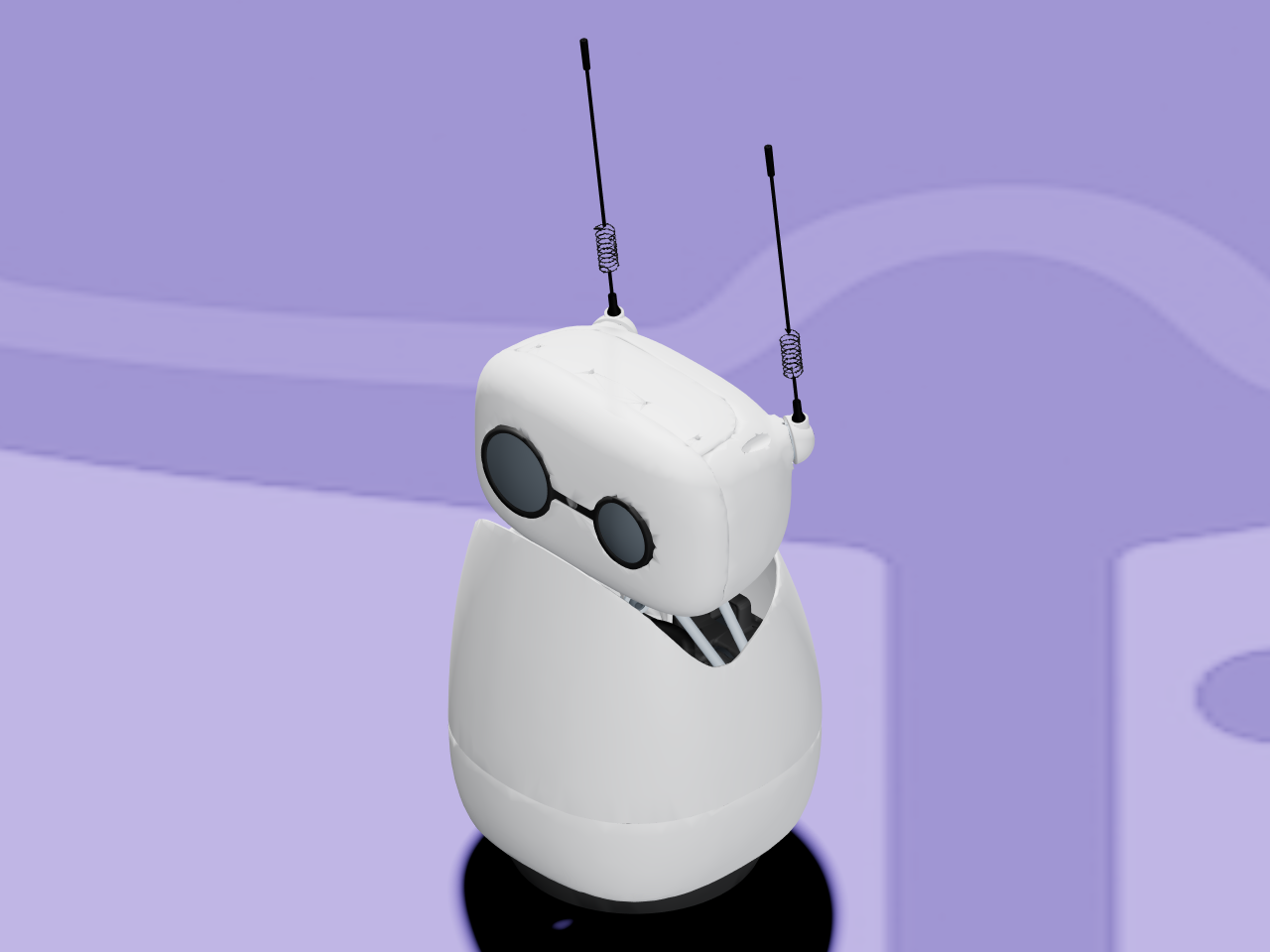
Reachy Mini is a compact, expressive desktop robot from Pollen Robotics and Hugging Face, aimed at people who want to experiment with embodied AI without a lab. It is small enough to sit next to a monitor, and almost all of its personality comes from how it moves.
What makes it interesting
The head does not sit on a conventional serial neck. It rides on a six-degree-of-freedom Stewart platform — six linear actuators driving a single moving plate in parallel — which gives it fluid, lifelike tilts and translations that a stack of revolute joints struggles to reproduce. Add a body yaw rotation and two independently animated antennas and you get nine actuated degrees of freedom in a robot you can pick up with one hand.
The hardware also carries a wide-angle camera, a microphone array, and a 5 W speaker, and ships with a Python SDK plus a MuJoCo simulation. It comes in two versions — a Wireless model built around a Raspberry Pi CM4 with an onboard battery, and a USB-tethered Lite developer model. Both share the same mechanism, so this one description covers either.
What to expect in ARMOR
All three variants load and render identically, with per-link materials from the URDF. They share the same 41 meshes, so the download is the same size whichever you pick — the only difference is how much collision geometry the model declares:
- Full collision — every part has a collision shape. Pick this for MuJoCo physics where parts should actually contact one another.
- Simplified collision — coarser shapes, so contact solving is cheaper and the tightly packed Stewart linkage produces fewer spurious self-collisions.
- Visual only — no collision geometry at all. Ideal for viewing the model and for AR, where nothing is being simulated.
You can switch later by importing a different variant; they are separate projects.
One caveat worth knowing
URDF cannot express closed kinematic loops, and a Stewart platform is nothing but closed
loops. The upstream description works around this by encoding the six legs as passive_*
joints together with dummy closing_* frames, which downstream solvers like PlaCo use to
re-close the chain. ARMOR reads the URDF as written, so the six legs appear as independent
open chains — driving a leg joint moves that leg alone rather than the platform as a whole.
The geometry, inertia, and rendering are all faithful; it is the loop closure specifically
that URDF leaves on the table. This is a property of the format, not of ARMOR or of the
upstream model.
The description is generated from a public Onshape assembly with onshape-to-robot, and the meshes are decimated on export, so the STL set stays manageable on a phone.