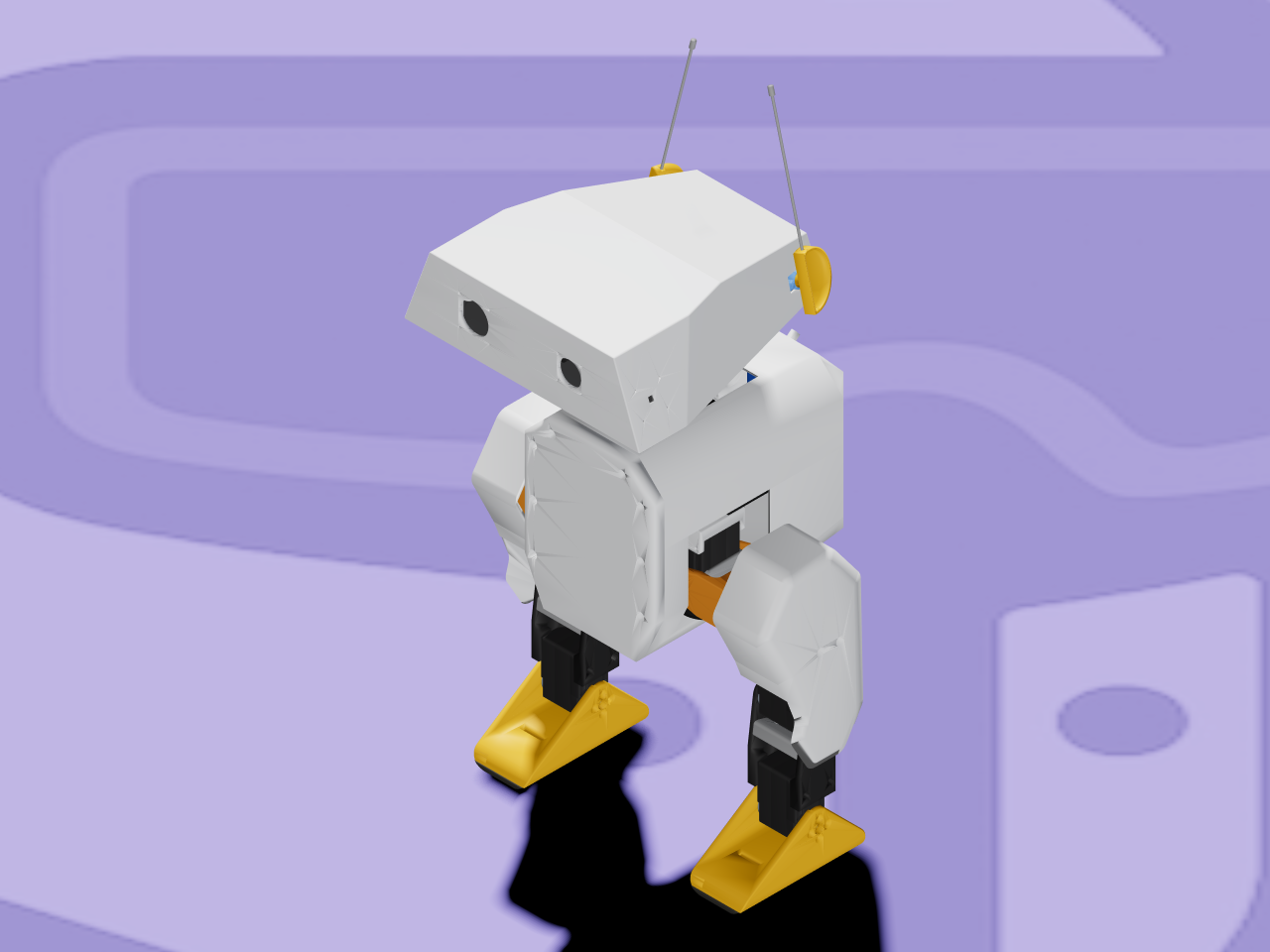
Open Duck Mini is an open-source, 3D-printable miniature biped — about 42 cm tall standing on extended legs — built around inexpensive hobby servos, with a full bill of materials aimed at staying under $400. It’s a hands-on platform for learning legged locomotion: walking policies are trained in simulation with reinforcement learning, then transferred to the real hardware.
The mechanism
Each leg has five actuated joints — hip yaw, hip roll, hip pitch, knee, and ankle — for ten leg DOF total, plus a four-axis neck and head (neck pitch, head pitch, head yaw, head roll) for expression, bringing real actuated DOF to fourteen. The URDF also models a pair of antenna joints for the robot’s expressive “ears,” but on the current hardware revision they’re passive — posable by hand, not driven by their own motor — so they aren’t counted in the fourteen.
About this file — read before importing
This links directly to Open_Duck_Mini (the
v2 branch), the project creator’s own repository — there’s no company behind this robot,
so this genuinely is the primary source, not a third-party stand-in. ARMOR links directly
to that repository rather than re-hosting anything, so what you get is exactly what’s
published there, unmodified.