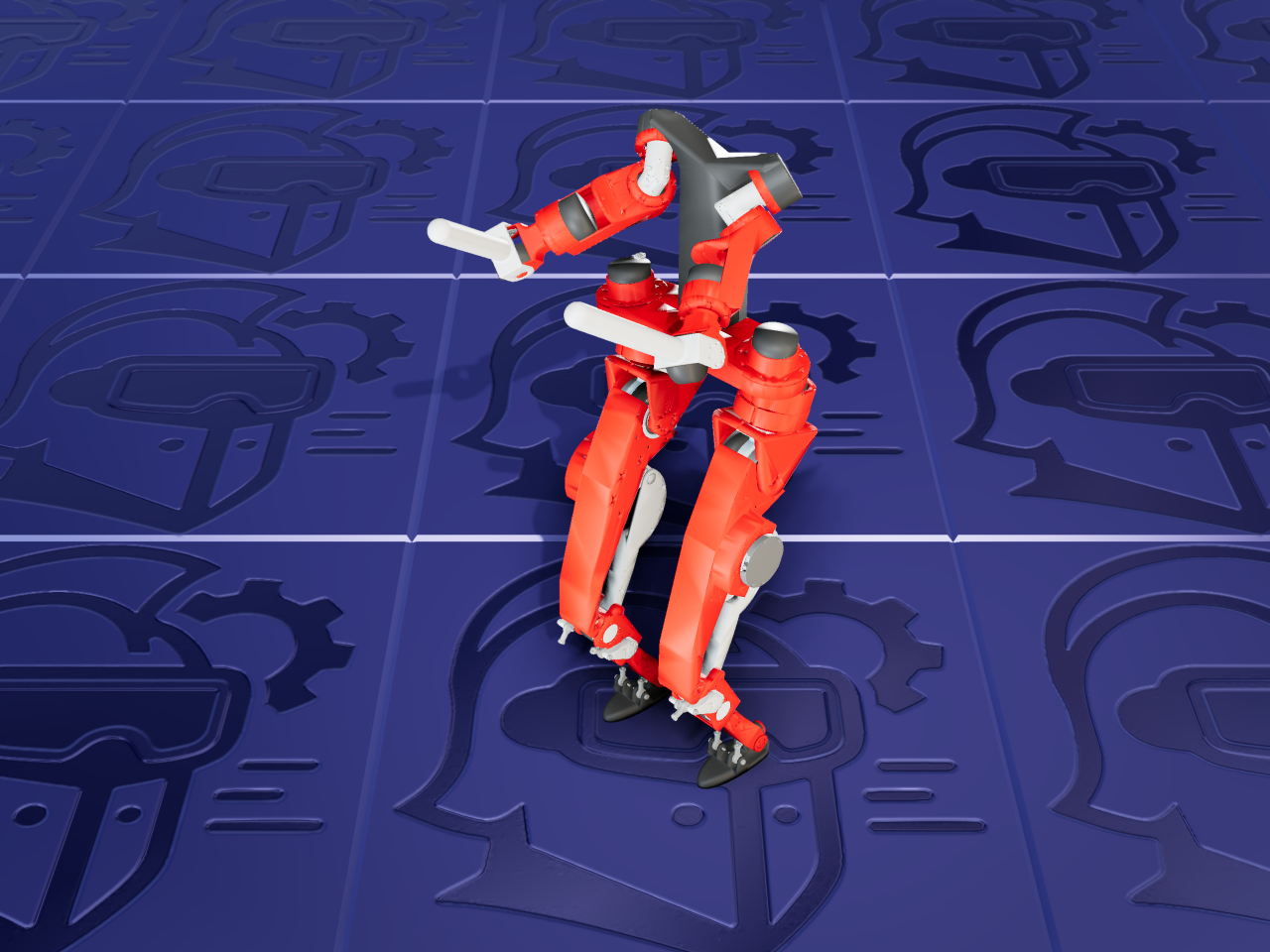
LeRobot Humanoid is an open project from Hugging Face’s LeRobot team to build a low-cost, reproducible humanoid robot. Most of its custom parts are 3D printed, and the project’s stated hardware cost target is under USD 5,000. The project spans five repositories, from design studies and build instructions to a runtime and simulator identification; this entry links to the one that holds the robot models.
The mechanism
Each leg has six revolute joints: a hip with three axes (z, x, y), a knee, and a two-axis ankle (y, x). Two legs give twelve actuated degrees of freedom on the biped, with no mimic joints and no closed kinematic loops. The humanoid variant adds a four-joint arm to each side (three shoulder joints and an elbow), for twenty.
Which variant?
The biped without arms is the robot the project’s runtime loads and the platform its hardware repository documents. The humanoid is the design the project is working toward, with arms that are not built yet. The fixed upper body variant is the biped carrying an arm and shoulder assembly and a 4 kg torso mesh as rigid parts, which have no joints of their own; it tests the legs under the added load.
Joint limits — read before simulating
The joint limits in these files are export defaults, not the robot’s real limits. Every joint is limited to ±180° (±π rad), 10 N·m of effort, and 10 rad/s, so in ARMOR a knee or ankle can swing through ranges the hardware cannot reach. Treat the models as accurate geometry and mass, and set realistic limits yourself before relying on a simulation.
About this file — read before importing
This links directly to the models folder of Hugging Face’s
lerobot-humanoid-model
repository. ARMOR links directly to that repository rather than re-hosting anything, so
what you get is exactly what the project publishes, unmodified.