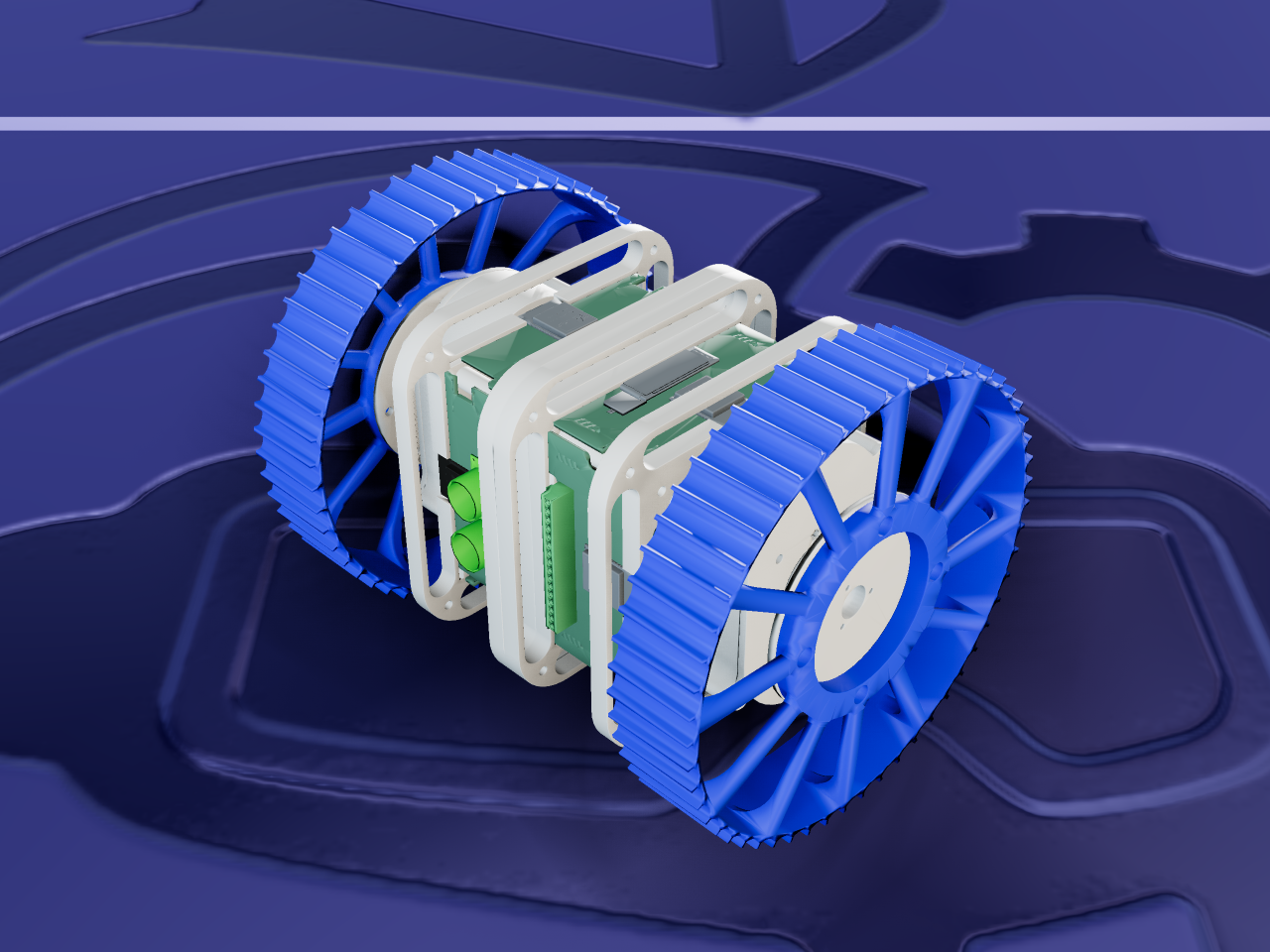
The GEMS Mobile Robot is a differential-drive wheeled base built from two GEMS Servomotor units, a trailing support caster, and a shared chassis — part of the GEMS (“Graceful Equalising of Mechatronics Students”) Erasmus+ project’s open-source mechatronics education hardware. Per the project’s own description, the two servo modules are mounted with their electronics facing down for stability, one sensor module facing forward and the other backward, so the robot can detect obstacles on its path in either direction — coordinated over wireless communication in the real hardware.
The mechanism
Both servos’ housings bolt rigidly together into one chassis; each servo’s own output shaft independently drives its own wheel — two actuated degrees of freedom, a genuine differential drive with no shared or coupled motion between the wheels. A third, passive caster wheel trails behind for stability (visible at the base of the chassis) — present in the model but not independently articulated, the same simplification applied to other passive caster wheels elsewhere in this gallery.
About this file — read before importing
GEMS_Mechanics ships only native FreeCAD (.FCStd) source files — no pre-exported URDF, STL,
or STEP. This model was generated directly from that upstream FreeCAD assembly by a
purpose-built conversion pipeline (real OpenCASCADE geometry, real per-part color decoded
from the CAD’s own material data — no FreeCAD installation used at all), then self-hosted
here since no ready-to-link file exists upstream to point to instead. It’s shared under the
same CC BY-SA 4.0 license as the original CAD.
Parts sealed inside each servo’s housing and never externally visible on the assembled unit — fasteners, the internal gear train, and the motor/bearings — are omitted from the mesh entirely rather than modeled, keeping each mesh within the app’s real per-mesh triangle budget. Each of the four internal electronics boards’ own substrate shape and real color are kept (visible through the housing’s open frame), along with any individual board component large enough to matter (a connector, the ESP32 module, the ultrasonic sensor’s transducer pair) — only the swarm of genuinely tiny surface-mount parts (resistors, small ICs) is left out. See NOTES.md for the measured reasoning and exact size threshold.