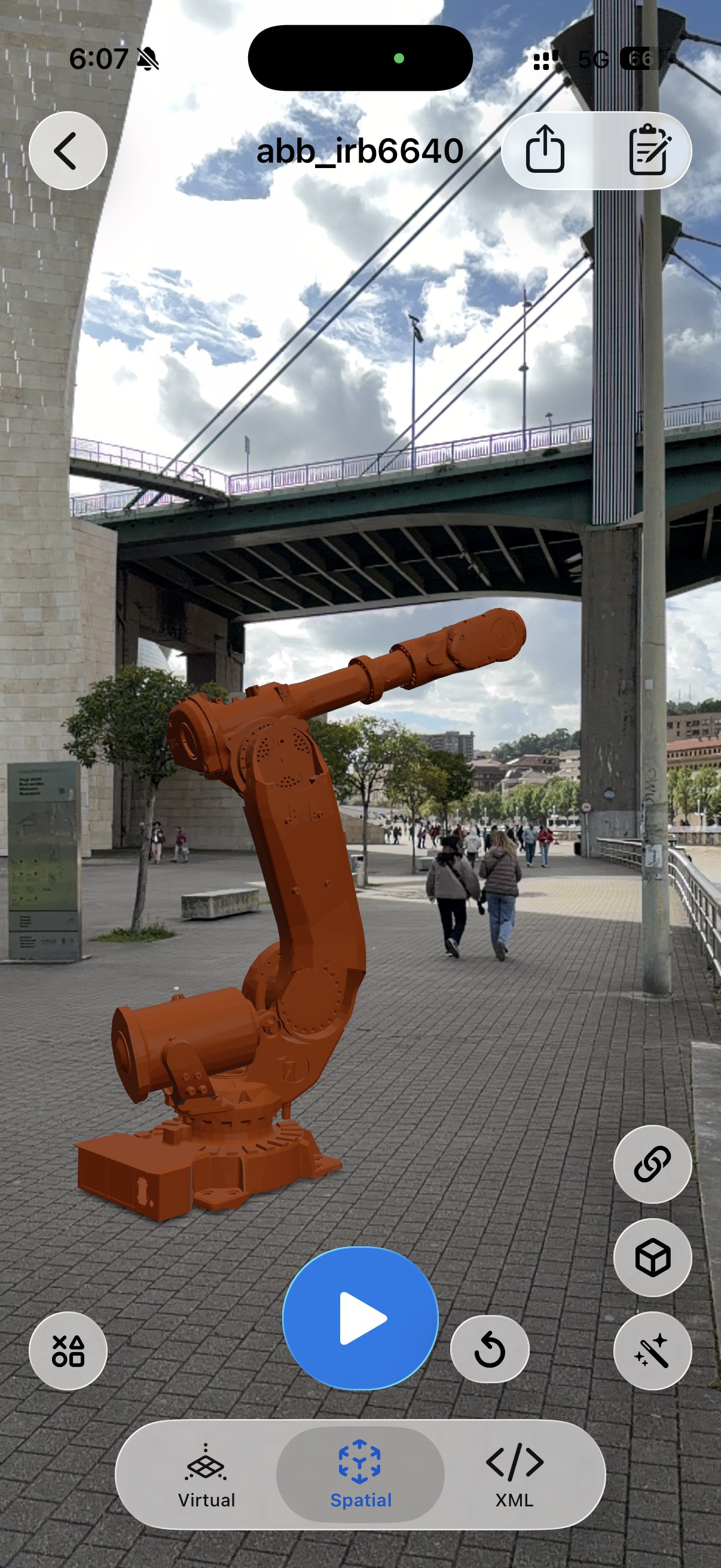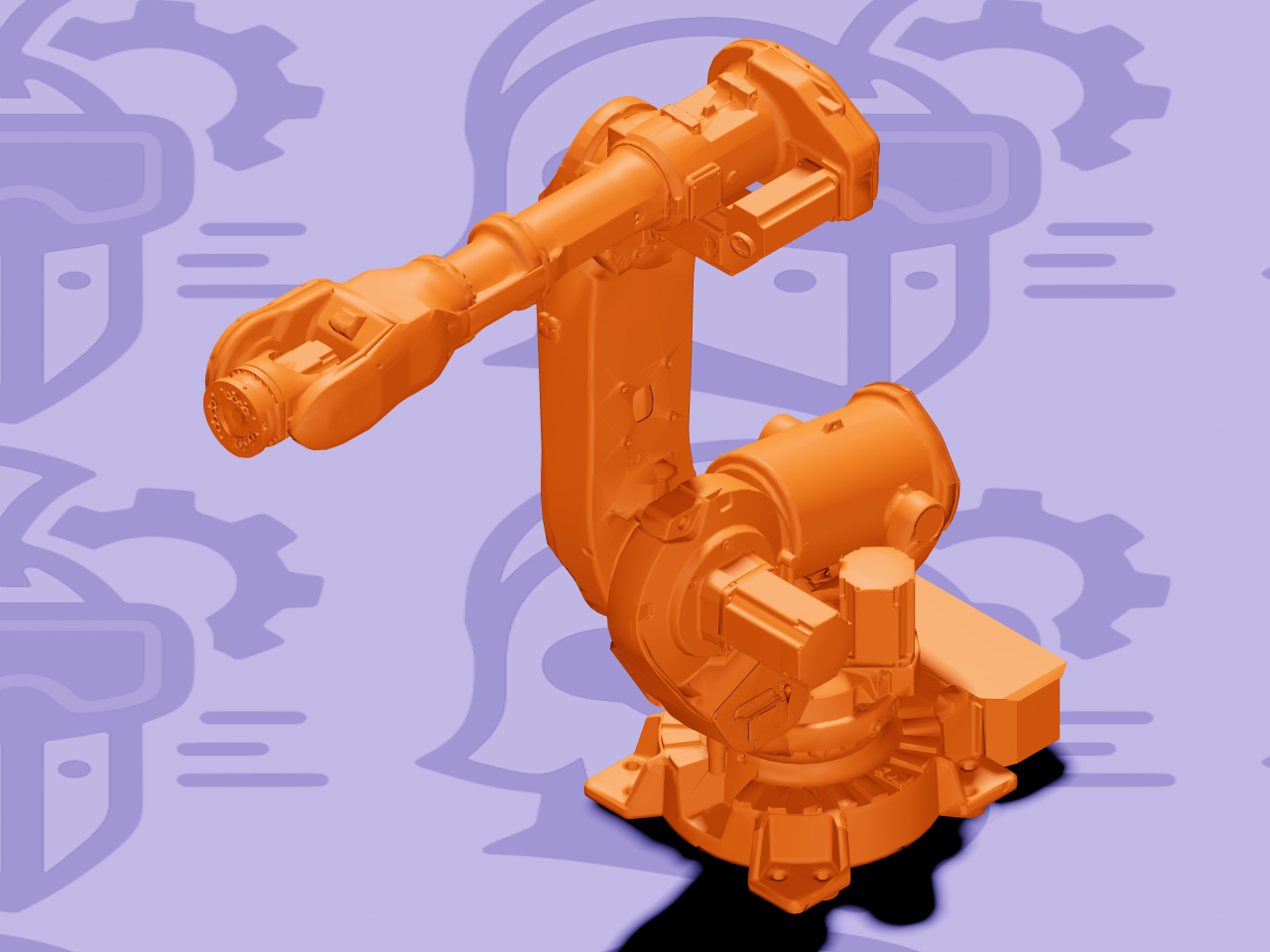
The IRB 6640 is ABB’s heavy-payload six-axis arm, built to replace the older IRB 6600 on factory floors that need serious reach and payload together — spot welding, material handling, and machine tending on parts too large or heavy for a typical cobot.
The mechanism
Six revolute joints in series give the arm its six degrees of freedom. Visually,
there’s a seventh moving part: a cylinder-and-piston assembly running alongside
link_1 and link_2, which looks like a linear actuator but is a gas spring,
counterbalancing the weight of the upper arm the same way a car’s hatchback strut
does. In the “185-280” variant it’s even encoded as two continuous joints carrying
<mimic joint="joint_2"> — mechanically tied to the shoulder’s own motion, not
independently driven. Six axes, not eight, either way.
Choosing a variant
Both describe the same real robot family, from the same ROS-Industrial project, but they are two distinct upstream engineering files, not two levels of detail on one file:
- IRB 6640 — the original ROS-Industrial description, all-STL, and the exact file the screenshot above was taken from. Upstream doesn’t tie it to a specific payload/reach number.
- IRB 6640-185/2.8 — the package ROS-Industrial’s own documentation recommends today, matching ABB’s published 185 kg / 2.8 m data sheet. Slightly longer inner arm segments than the standard variant, and higher-detail COLLADA visual meshes.
If you just want to see the robot, either works — the picture above is “IRB 6640”. If the specific payload/reach rating matters to you, pick “185/2.8”.
About these files — read before importing
ABB does not publish a URDF for its robots. Both variants come from ROS-Industrial, the open-source community project that maintains description and driver packages for industrial robots ROS needs to talk to, maintained by Southwest Research Institute under the Apache License 2.0. They are careful third-party engineering models, not files ABB itself ships or verifies; treat them as accurate enough to visualize and plan around, and check ABB’s own data sheets before relying on either for anything load-bearing.
ARMOR links directly to that repository rather than re-hosting anything, and expands the macros itself after downloading — both variants are published as xacro upstream, and what you get is exactly what ROS-Industrial publishes, unmodified.